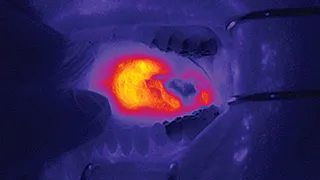
Gao is a scientist. Sumer is a surgeon. Mostly, Gao says, scientists and doctors “tend to stay siloed in their areas of expertise.” But Gao says it is necessary to put the two in the same room: Sumer provides insight into what would help a surgeon, while the Gao lab develops new technologies that solve Sumer’s needs in the operating room.
At UT Southwestern, it’s become idiosyncratic for biomedical scientists to work hand in glove with surgeons, as the Medical Center works to solve a larger question: How do you translate something from the lab to the operating room, from a study to an actual patient? And how do you do it quickly?
“People call this the Valley of Death,” Sumer says. “All these great ideas start in the basic science lab; thousands and thousands of ideas, and most of them — 99 percent, 99.9 percent — never reach the clinics.”
For Sumer and Gao, it’s not just about the discovery. Many scientists consider their work done when the paper is published, but the couple won’t be finished until they see their new technology in the hands of surgeons across the country.
OncoNano Medicine, a venture-backed startup cofounded by Sumer and Gao, who sit on the company’s scientific advisory board, is currently developing the technology and has secured grants from the Cancer Prevention & Research Institute of Texas and the National Institutes of Health. Sumer and Gao hope to see it in use in the next few years.
“Knowledge gain is good, but what’s the mission?” Sumer asks. “Research, discovery, yes, but also patient care.”