It’s 2004, and every patient in a particular medical trial has an early-stage form of lung cancer that’s medically inoperable. It isn’t a death sentence but it’s close.
Three-year survival rates hover between 20 and 35 percent, and the rate of keeping the primary tumor from spreading elsewhere isn’t much better. That’s until Dr. Robert Timmerman puts them on a new treatment plan.
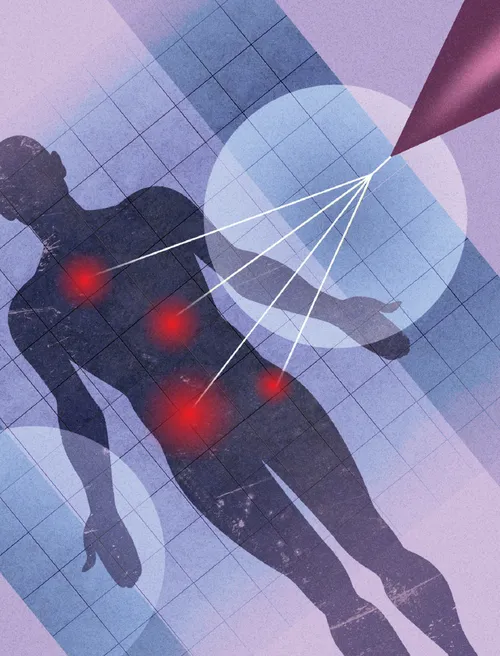
Back then, radiation was something like the Great Flood — spilling a high dose in all directions. Doctors made sure the radiation reached the tumors, but it often wound up touching places not at risk. Damaging healthy tissue was an inescapable part of getting through to the cancer. It’s what you went through for the chance to save your life.
Depending on the stage and aggression of the cancer, patients would typically spend many weeks undergoing daily radiation. This required low doses repeated day after day to avoid the treatment’s harmful side effects to the parts of the body to which cancer hadn’t spread.
But there was another way. Doctors were using newer technology to direct a highly concentrated blast of radiation to destroy tumors in the brain — the body’s most sensitive organ, and one that can’t afford to be harmed. Doctors used the treatment, called stereotactic radiosurgery, when they absolutely needed to hit their target with little tolerance for error — and it worked.
But initially, the treatment could only be used on the brain because brain tumors don’t move if the skull is stabilized, whereas tumors outside the brain move considerably with normal processes like breathing, so they couldn’t be targeted as directly. In the late 1990s, new technologies changed that, introducing the possibility that tumors in other areas of the body could be targeted.
Technology had caught up, but few doctors had. Early studies in the mid-1990s in the U.S., Japan, and Europe indicated that there wasn’t a lot of control in the way the radiation was delivered. But the results were still encouraging enough to pique the interest of American radiation oncologists — including Timmerman, a Professor of Radiation Oncology and Neurosurgery at the University of Texas Southwestern Medical Center, who couldn’t help but see the potential.